
Twelve Agents and a Founder: Running an AI-Driven Company
What a week of running HeatLens with an organisation of AI agents taught me about speed, control and the future of work
In my last post, When the Code Writes Itself, I described two shifts rewriting software: domain experts building their own tools, and AI becoming the layer that drives them. This post is about what happened next. Once the code could write itself, the bottleneck moved. It was no longer the engineering. It was everything around the engineering: testing, checking the numbers, keeping the website honest, watching the market, keeping the roadmap tied to what users actually need.
So I gave those jobs to agents too.
Some context first. HeatLens is a platform for integrated, whole-home heat pump retrofit. It supports UK heat pump professionals across the whole journey. It starts with pre-survey evidence, extracted from EPCs, floor plans and photos and reviewed before use. It then covers the design: room-by-room heat loss following the CIBSE Domestic Heating Design Guide method based on BS EN 12831-1, emitters, heat pump and cylinder sizing, retrofit scenarios, solar and battery, and running costs. After that come quoting, installation, handover and aftercare. Finally, monitoring compares measured performance against the original design. I built it because heat pumps succeed or fail on the quality of the whole system, not one calculation. When I retrofitted my own home, ten quotes for the same house recommended heat pumps ranging from 5 to 10 kW. My research career was largely about the gap between predicted and measured building performance, and HeatLens is designed to close that gap in practice. You can read more about how HeatLens works and my own home's energy transition.
Behind HeatLens, I now run what is effectively a small company of AI agents, orchestrated through Paperclip, an open-source tool for running "companies" of agents with an org chart, roles, budgets, goals and a ticketing system. I'm the board. They are the staff.
It has been the most exciting and the most unsettling thing I have done in my career. Both reactions are worth unpacking. So is a common misreading. This isn't "vibe coding", and it isn't something I picked up overnight. The way the company is designed draws on more than fifteen years of research and practice in building energy, fault detection, data, software and business.
The organisation
The HeatLens company has twelve agents. Each one is a Claude instance with a written role, a manager, a monthly budget cap, a memory file and a set of rules it must read before it does anything. The more judgement-heavy roles (orchestration, architecture, product, calculation standards and audit) run on Claude Opus; the execution roles run on the faster, cheaper Claude Sonnet.

In brief, here is who does what:
| Agent | Role | What they own |
|---|---|---|
| Joss | CEO | Turns goals into issues, assigns work, runs the nightly operator review and weekly scorecard, and is my single point of contact |
| Vern | CTO | Architecture, dependencies, deployment risk and sequencing the build lane |
| Ada | Backend and data | Calculation engines, data schemas, reports and exports |
| Ellis | Product engineer | Pages and feature UI, built to Casey's specs and checked in a browser at desktop and mobile widths |
| Clare | Calculation standards | The evidence behind every number: BS EN 12831, MCS, tariffs, savings and report wording |
| Maggie | QA and release | The release gate, regression fixtures and a nightly health check |
| Casey | CPO | Specifications, UX, market and policy research, and a nightly drift sweep |
| Clara | Customer success | Pilot operations, onboarding and turning feedback into product evidence |
| Finance | Finance and compliance | Monthly strategy and compliance check, quarterly options paper |
| Billie | Billing and revenue | The billing gate: pricing, entitlements and VAT |
| Mara | Growth | Website, claim register, social drafts and the weekly content plan |
| Guardian | Independent audit | Read-only weekly audit of everyone's work against the gates |
This was not the first draft. The initial proposal had sixteen agents. I cut it to eleven on day one by merging overlapping roles, then added a dedicated frontend engineer and restructured reporting lines the next day. It felt exactly like an early-stage reorg, except it happened in an afternoon.
A few separations I kept deliberately, because they mirror principles any good organisation would recognise:
- QA is not the builder. Maggie's instructions say it plainly: if you wrote the change, you do not approve its release.
- The auditor audits everyone. Guardian is read-only and independent. If the CEO agent is the subject of a finding, it escalates straight to me.
- Calculation integrity has its own owner. Clare owns the evidence behind every number HeatLens shows a customer: BS EN 12831 and MCS methodology, tariff assumptions, savings claims. In a product whose value depends on defensible heat loss calculations, that role is the moat.
The company has a mission, a North Star metric (defensible assessments delivered per week, meaning reports exported with no unresolved missing-data flags) and dated goals running through to the end of 2027. Every agent reads the same company brief at the start of every run, including a section titled "Honest gaps" that lists what isn't working yet.
What actually happens when I change a feature
This is where the model earns its keep. When I change something in HeatLens, the work doesn't stop at the code. The change ripples through the organisation in a way that a solo founder could never manage alone.
- Specification and build. Casey turns the idea into a specification with acceptance criteria. Vern sequences it. Ellis or Ada builds it on a branch and opens a pull request. Nothing reaches the live app without going through review.
- Accuracy checks. If a change touches a calculation, a report figure or the wording around one, it must pass Clare's calculation evidence gate. Her rule is that we do not claim compliance with SAP, EN 12831 or MCS unless the implementation and its outputs have actually been reviewed.
- Knock-on impacts. Every release candidate generates a note listing which gates its files touch, and pulls in the relevant owners: Casey for workflow acceptance, Clare for calculations, Billie for billing, Mara for public copy, Clara for onboarding and support. Every night, Casey sweeps every file changed in the last 24 hours looking for drift, on the basis that drift usually starts where a new feature meets an old page.
- Marketing stays in step. Mara owns the website, the claim register and the content plan. When features change, the feature list and claims are re-checked against an approved-claims register. Her gate has my favourite rule in the whole setup: keep unsupported claims visible as unresolved, and do not smooth them into persuasive copy.
- Strategy keeps watching. There is no single "strategy agent". Strategy is distributed. Joss runs a nightly operator review that turns customer feedback clusters into draft roadmap proposals, a weekly scorecard against the North Star, and a monthly board pack. Casey runs a weekly market and policy watch. Finance runs a monthly strategy and compliance check, with a quarterly options paper.
- Independent assurance. Every Sunday, Guardian audits the week's issues, pull requests and outputs against the gates and the public-claims rules, and raises findings.

A real example from this week shows the chain working. While preparing updated figures for the HeatLens features page, Clare found that the radiator output values in the emitter engine were unsourced, and sat 15% to 31% below two current UK manufacturer catalogues. She wrote an evidence note with four options and showed how client-facing numbers would move under each. I rejected her first recommendation and asked for a check at heat pump flow temperatures. She revised it, and I approved. The note then assigned Maggie to re-pin the regression tests, and flagged that the marketing figures she had prepared for the features page would need recomputing before they could ship.

One discovery on a marketing task became a methodology decision, a test change and a website correction, all linked, all traceable, and all waiting on the one decision that was genuinely mine.
Where I fit: from engineer to director
The governance model is the part I'd recommend to anyone trying this. Every decision is classified on a four-level scale. At levels A and B the agents act and log what they did; at levels C and D they must stop and raise an approval for the board.

Anything not explicitly listed is level C by default. New features, live deployments, public claims, pricing and calculation methodology all sit at C or D. Hiring a new agent requires board approval. "Silence never counts as approval."
The agents never deploy to the live app. Only I publish. They never send external messages, move money, or contact regulators or customers. They hold the minimum credentials they need, which is deliberate: no single agent should ever read untrusted input, touch sensitive data and act externally at the same time.
The effect on my working day has been profound. I spend my time doing the things I am actually best placed to do: talking to installers and assessors, understanding what they need, deciding what HeatLens should become, and directing the engineering. I approve decisions on cards that arrive with the evidence attached. I can express an idea in the morning, see it running on a branch by lunchtime and get real feedback on live code that afternoon.
The numbers are hard to believe even for me. In its first week of operation the company has worked through nearly 800 tracked issues and over 800 commits have landed in the HeatLens repository. Work that would have needed a team of eight to ten people, and months of hiring, now runs on a single subscription.
Work branches opened per agent in week one (49 in total)
Chart data
| agent | branches |
|---|---|
| Ellis (frontend) | 19 |
| Joss (CEO) | 8 |
| Ada (backend) | 6 |
| Maggie (QA) | 6 |
| Mara (growth) | 3 |
| Vern (CTO) | 3 |
| Billie (billing) | 2 |
| Clare (standards) | 1 |
| Finance | 1 |
This isn't vibe coding
From the outside, all of this could look like "vibe coding" at scale. It isn't, and the difference matters.
Andrej Karpathy coined the term in February 2025 to describe a playful way of building: accept every change the AI suggests, stop reading the diffs, and let the code grow beyond your own comprehension. He was clear about where it belonged: "not too bad for throwaway weekend projects".
A year later, in February 2026, he proposed a name for what professionals were actually doing with agents: agentic engineering. It is agentic because you are no longer writing the code directly most of the time. It is engineering because, in his words, "there is an art & science and expertise to it". He developed the idea in his fireside chat at Sequoia's AI Ascent in April 2026, titled From Vibe Coding to Agentic Engineering. His framing is that vibe coding raises the floor, letting almost anyone build something, while agentic engineering raises the ceiling. But that only holds if you keep the quality bar of professional software. You remain responsible for your software, exactly as before. The agents are extremely capable but "jagged": brilliant at some tasks, careless at others. So you have to stay in the loop. His closing line has stuck with me: "You can outsource your thinking, but you can't outsource your understanding."
His earlier talk, Software Is Changing (Again) at Y Combinator's AI Startup School in June 2025, made a related point. The best AI products offer partial autonomy, with an "autonomy slider" the human controls. They make the loop between the AI generating and the human verifying as fast as possible. My A to D decision levels are exactly that slider, written down.
That distinction is what the HeatLens company is designed around:
| Vibe coding | Agentic engineering at HeatLens | |
|---|---|---|
| Who checks the change | Nobody: accept all | Maggie gates every release; Guardian audits every week |
| Where the numbers come from | Whatever the code produces | Clare traces each figure to evidence: BS EN 12831, MCS, sources |
| What gets claimed publicly | Whatever sounds good | Only claims in Mara's approved register; new claims are a board decision |
| What reaches users | Straight to live | Branch, pull request, gates; only I publish |
| Who is accountable | Unclear | A named owner and a logged decision for every change |
| Best suited to | Prototypes and experiments | Software people rely on to make real decisions |
I still vibe code. It's how an idea becomes a clickable prototype in an afternoon. But the moment that idea affects how a real heat pump is sized for a real home, it has to cross over into engineering.
It didn't happen overnight
The tools are new. The thinking behind how I've organised them isn't. It goes back more than fifteen years across research, teaching, industry and business, and almost every design choice in the agent company traces to something I learned the slow way.
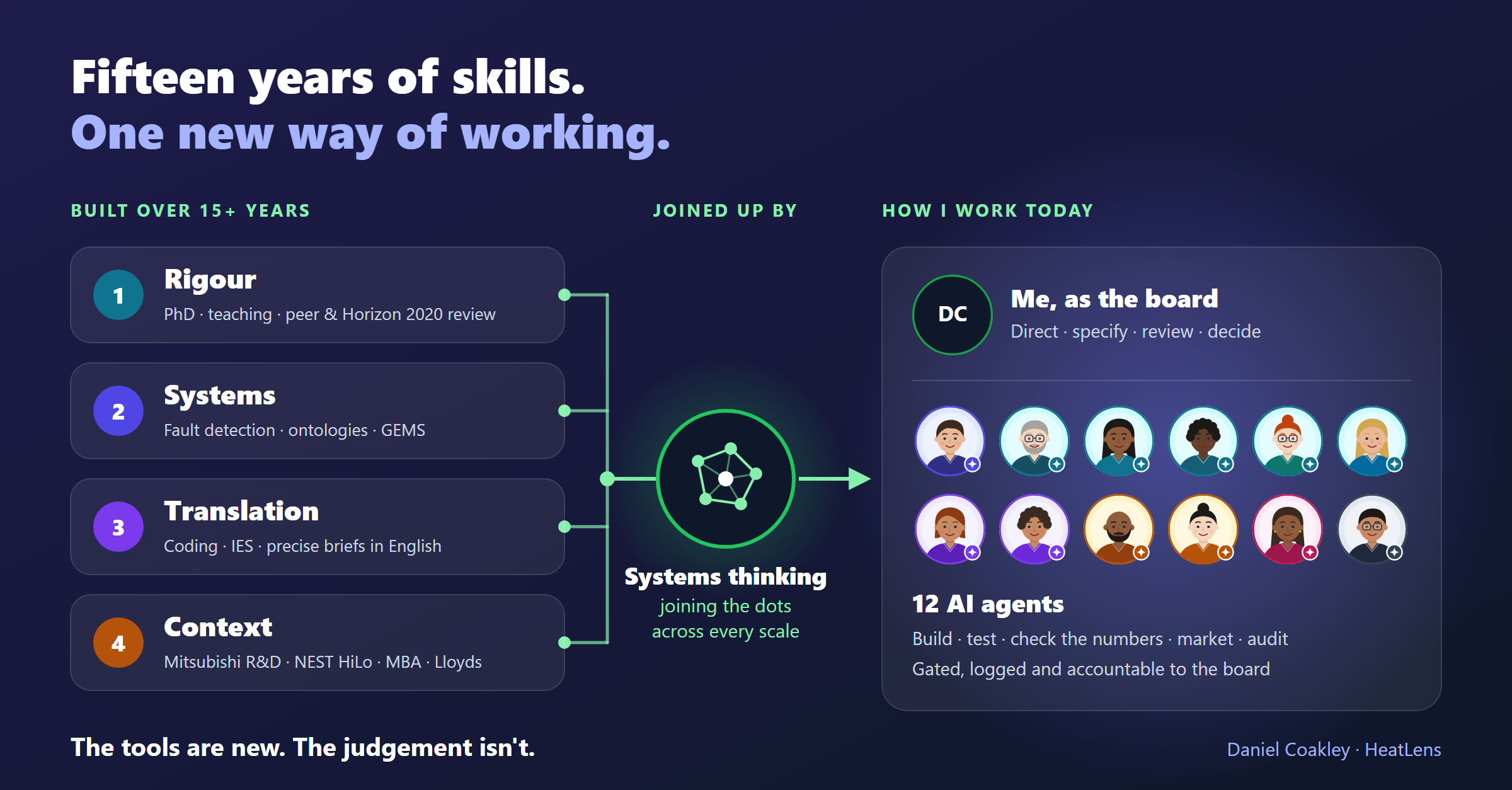
Looking back, that experience falls into four groups of skills. Each one maps onto a specific part of how the company works.

1. Rigour: evidence, checking and review
Evidence before answers (PhD, 2009 to 2012). My PhD, supervised by Dr. Marcus Keane, was about calibrating detailed building energy simulation models to measured data, and doing it honestly, with uncertainty made explicit. Working with Paul Raftery, we published a review of methods to match building energy simulation models to measured data, which has since been cited more than 1,300 times. The lesson that stuck with me is that a model can match the bills and still be wrong. Every assumption needs evidence, and the evidence needs to be traceable. Marcus was a mentor as much as a supervisor, and he introduced me to many of the leading thinkers in the built environment, people whose standards for rigour I still measure my own work against.
Reviewing other people's work (teaching and research). Alongside my research, I taught and supervised students, which meant regularly reviewing their work: finding the gap in an argument, the untested assumption, the result that looks right for the wrong reason. I've also completed peer reviews for academic journals, and served as an expert reviewer for research proposals under the EU's Horizon 2020 programme. Reviewing is a distinct skill from producing. You learn to read quickly, test claims against evidence, and give feedback someone can act on.
In the agent company: this is Clare's calculation evidence gate, Maggie's release gate and Guardian's weekly audit. It is also most of my own job. Reviewing what twelve agents produce is not so different from reviewing a stack of student reports or a round of grant proposals.
2. Systems: data, abstraction and governance
Systems that check themselves (post-doctoral research). My post-doctoral work moved into automated fault and anomaly detection. Much of it was with my colleague Peter O'Donovan, alongside Ken Bruton and Dominic O'Sullivan. Together we developed data abstraction, analysis and cloud-based tools for automated fault detection and diagnosis in air handling units on industrial sites, published as AHU InFO. Peter and I had regular, lengthy discussions that introduced me to the world of independent software abstraction layers and cyber-physical systems. His later work on a fog computing industrial cyber-physical system for embedded, low-latency machine learning shows that way of thinking at its best: separate layers, each doing one job, talking through well-defined interfaces. Around the same time, I worked on making building data machine-readable through ontologies and linked data. That included semantic web technologies for building data with Edward Corry, James O'Donnell, Edward Curry and Pieter Pauwels, and the Waternomics water information platform.
Governance at scale (Boston Scientific, 2015 to 2017). I then collaborated with Boston Scientific on a global energy management system (GEMS) for non-energy-intensive, multi-site manufacturers, working with Noel Finnerty, Raymond Sterling and Sergio Contreras. Part of that work was an energy management maturity model for organisations operating across many sites and countries. It taught me how a large organisation turns policy into consistent practice: defined responsibilities, measurable targets, and a clear picture of how mature each process is.
In the agent company: fault detection is why the system doing the work is never the only thing checking it. Abstraction layers are why every agent has one remit, a clean interface and clear handoffs. Ontologies are why every agent reads the same role definitions and company brief, a shared vocabulary for people and machines. And the GEMS work is where the company's goals, North Star metric, autonomy register and decision levels come from.
3. Translation: from needs to specifications
Writing code, independently and for years. Throughout this time I was writing software myself: Java, VBA, Python, SQL, whatever the problem needed. I was never a professional software engineer, but I wrote enough code to understand how systems fit together and, more importantly, to read code critically. That matters more now, not less. When agents write most of the code, reading it is the job.
The racing driver Jackie Stewart is often quoted as saying:
You don't have to be an engineer to be a racing driver, but you do have to have mechanical sympathy.
That is exactly the relationship I want with my agents. I don't need to write every line myself, but I need to understand the machine well enough to feel when something is wrong, and to know what to ask of it.
Translating needs into specifications (IES, Glasgow). After that, I joined a software team at IES in Glasgow, in a role that sat between consultancy and software development. Much of my time went on translating what practitioners needed into specifications that developers could build. I didn't appreciate it at the time, but on reflection I think this is where I learned what may now be the most valuable skill in software. Karpathy put it memorably back in 2023: "The hottest new programming language is English".
The important part isn't the English. It's the clarity of what is communicated. A vague brief gets you a plausible answer; a clear one gets you the right one. That means being explicit about the context, the objective, the constraints, who the output is for, what format it should take and how you will know it is done. Structured prompting frameworks such as CO-STAR (context, objective, style, tone, audience and response), CRAFT and RISE are, at heart, formalised versions of a good requirements brief. What's now called prompt or context engineering is the same discipline I practised at IES, with a different reader on the other end.
In the agent company: every specification Casey writes has a problem statement, acceptance criteria and the evidence it depends on. Every direction I give the agents is written the same way. When something comes back wrong, the first thing I check is not the agent. It is my brief.
4. Context: domain and commercial judgement
Knowing the technology inside out (Mitsubishi Electric R&D, five years). Five years at Mitsubishi Electric's R&D centre gave me the domain depth. I worked on heat pump product design and development, controls integration and thermal comfort, and on how heat pumps integrate with wider energy systems. During that time I collaborated with researchers at the Technical University of Denmark, including Bjarne Olesen and Ongun Kazanci, on comfort-based control and ventilation. With RWTH Aachen, including Christian Vering and Dirk Müller, I worked on digital twins for HVAC systems. I also worked on demand-side response using heat pumps. And with Professor Arno Schlueter and Gearóid Lydon at ETH Zurich, I worked on NEST HiLo, a research unit in Empa's NEST building in Dübendorf that opened in 2021. HiLo combines an adaptive solar façade, floors with integrated heating, cooling and ventilation, and two-way thermal and electrical connections to NEST's district energy hub, all designed to work as one system. I learned how the technology really works, and why sizing, flow temperatures, emitters and controls decide whether a heat pump delivers on its promise.
The business, not just the technology (MBA). Next I completed an MBA, which broadened me beyond engineering into finance, data, management, marketing and HR. My capstone looked at ESG in corporate real estate, analysing 1.2 million UK energy records against listed property portfolios. I found that ratings, certifications and real building performance are only weakly connected.
Commercial reality at scale (Lloyds Banking Group). Most recently, my time at Lloyds Banking Group has been key to my commercial awareness. I've worked with large-scale property portfolios, enterprise SaaS solutions, and partner organisations across construction and smart buildings technology. It showed me how large organisations buy, assure and adopt technology, and how much governance, evidence and trust matter before anything is used at scale.
In the agent company: this is the part I keep for myself as the board. The agents can write the code. They cannot tell you which number an installer will be challenged on, which assumption a homeowner will question, or what a portfolio owner or enterprise buyer needs before they trust a tool. It is also why the company has Finance, Billing and Growth agents rather than just an engineering team, and why its roadmap points toward landlord and assurance pilots. All the software knowledge in the world is useless without practical domain expertise. That judgement, technical and commercial, took me years to build, and it is the one part of HeatLens I can't delegate.
The thread through all of it: joining the dots
Looking back, the common thread isn't any one discipline. It's integrated systems thinking: joining the dots between many elements, at different scales and levels of detail, and seeing how a change in one place ripples through the rest.
I've applied that same habit everywhere. A heat pump only works if the fabric, rooms, emitters, flow temperature, controls, tariff and the people living there work together. In integrated building controls you design how sensors, plant, software and occupants interact, not each one in isolation. NEST HiLo was the clearest physical embodiment of that I've worked on: architecture, structure, façade, heating and cooling, controls and a district energy network, designed as a single integrated system at real scale. My PhD literature review meant synthesising decades of calibration methods from different fields into one coherent picture. The MBA meant connecting finance, data, marketing, operations and people into a single view of a business. HeatLens is built the same way: one integrated journey from pre-survey to performance monitoring, because a correct heat loss figure is worthless if the emitters, the installation or the controls let it down.

Agentic engineering rewards exactly this skill. When agents can produce each individual part, the human value moves to how the parts fit together. The radiator example earlier is a good illustration. One figure in an engine became a methodology decision, a set of regression tests and a correction on the website. Spotting that chain, and zooming from a single number to the whole business and back again, is the work the agents can't yet do for me.
The research has several names for it. Peter Senge called systems thinking The Fifth Discipline, the one that ties the others together. Roger Martin describes integrative thinking: holding the whole problem in mind while working on its parts. Most recently, Martin Fowler and colleagues at Thoughtworks wrote about expert generalists, people with a skill for spanning many specialties. They argue the skill becomes more valuable with the arrival of LLMs and AI tools. The wider data points the same way:
- The World Economic Forum's Future of Jobs Report 2025 lists systems thinking among the skills rising in importance to 2030. It links that rise to managing interactions with autonomous technology. The two most important core skills today are analytical thinking, and resilience, flexibility and agility.
- Microsoft's 2026 Work Trend Index found the human skills that matter most as AI takes on more work are quality control of AI output (50%) and critical thinking (46%). Its "Frontier Professionals" are defined by refusing to outsource their thinking.
- The Harvard and BCG "jagged frontier" study found consultants using AI were faster and better on tasks inside AI's capabilities. They were 19 percentage points less likely to get the right answer on tasks just outside them. Knowing where that boundary sits, and when to integrate AI at a finer level of detail, is itself a judgement about the whole system.
It is a skill you have to train. The evidence that systems thinking can be taught is encouraging, if still thin. In one well-known study, school students following an earth-systems curriculum developed systems thinking in stages, and progress tracked how much they took part in activities that integrated knowledge. Abstract "brain training" transfers poorly. What works is practice on real systems. For me, that practice was fifteen years of buildings, controls, data and organisations. For anyone starting out now, I'd look for roles and projects that force you to connect the pieces, not just perfect one of them. To practise on a few real examples, try the interactive Systems Thinking Explorer.
It also takes a mental adaptation. The skills are only half of it. The other half is accepting a different relationship with the work: moving from producing to directing, from writing to reviewing, from being the person who knows how to do the task to being the person who knows whether it has been done well. That isn't easy for anyone whose identity is tied to their craft, and I've felt it myself. Microsoft's 2026 research is a useful reminder that this isn't only down to individuals. Organisational factors such as culture, manager support and talent practices were associated with about two thirds of reported AI impact, against about a third for individual mindset. Adapting is a personal shift, but organisations have to make room for it.
The bigger picture: the Frontier Firm is already here
None of this is unique to me. In its 2025 Work Trend Index, Microsoft described the emergence of the "Frontier Firm": organisations built around on-demand intelligence and hybrid teams of humans and agents. It introduced the idea of the "agent boss", someone who builds, delegates to and manages agents, and proposed the human-agent ratio as a new management metric. Its survey of leaders found:
Microsoft Work Trend Index 2025: what leaders expect (% of leaders)
Chart data
| statement | pct |
|---|---|
| Grow workforce with digital labour | 82 |
| Hiring for new AI roles | 78 |
| Agents already automate work | 46 |
| Teams train agents (5 yrs) | 41 |
| Teams manage agents (5 yrs) | 36 |
| Considering headcount cuts | 33 |
Microsoft's 2026 Work Trend Index has continued the theme, framing the shift around agents and human agency. My own experience is a small, concrete version of what Microsoft describes: one human director, twelve agents, a human-agent ratio of one to twelve.
The broader data points the same way. McKinsey's 2025 State of AI survey found 88% of organisations now use AI regularly, and 62% are at least experimenting with agents, but only 39% report any measurable impact on enterprise earnings.
The adoption gap: using AI is not the same as being organised around it (% of organisations)
Chart data
| stage | pct |
|---|---|
| Use AI regularly | 88 |
| Experimenting with agents | 62 |
| Any EBIT impact | 39 |
Most incumbents have adopted AI as a tool. Very few have reorganised around it. Gartner expects over 40% of agentic AI projects to be cancelled by the end of 2027, largely because of cost, unclear value and weak risk controls.
That gap, between adopting AI and being organised around it, is where I believe the disruption will come from. AI-native organisations have structural advantages that incumbents will struggle to match: radically lower cost bases, iteration cycles measured in hours rather than quarters, and no legacy structures to unwind. When they compete directly with incumbents, the incumbents will either reorganise or be leapfrogged. I think this will happen sooner than most people expect.
Who gets disrupted first: low moats versus regulated markets
Not every industry will move at the same speed. The deciding factors are the barrier to entry and the strength of the moat.

Low barriers, low moats: expect rapid disruption.
- SaaS point solutions. Narrow tools with simple workflows can now be rebuilt by a small AI-native team in weeks. In early 2026 the market started pricing this in, with a sharp software stock sell-off that analysts dubbed the "SaaSpocalypse".
- Education and homework help. Chegg cut around 45% of its workforce in late 2025, citing "the new realities of AI" and falling search traffic, following a 22% cut earlier that year.
- Customer support and outsourcing. Salesforce cut support headcount from around 9,000 to 5,000 as AI agents took on about half of conversations. Klarna said its AI assistant does the work of roughly 850 agents, though it also reversed course to guarantee customers can always reach a human. That reversal is a useful warning about pushing too far.
- Translation and content. A Society of Authors survey found over a third of translators had already lost work to generative AI.
- Marketing agencies, web development agencies and stock media. Their output is digital, their customers can switch easily, and AI-native competitors can undercut them on both price and speed.
High regulation, high governance: slower, for now.
Banking, healthcare and medical devices, pharmaceuticals, aviation and energy utilities are more protected. That is not because the technology doesn't apply. It's because regulation, certification and accountability prevent new entrants from gaining a foothold quickly. The EU AI Act reinforces this. Under the provisional agreement reached in May 2026, obligations for high-risk AI systems such as credit scoring and recruitment apply from December 2027, and for AI embedded in regulated products like medical devices from August 2028. That builds a compliance timeline into any disruption.
But "for now" matters. Regulation slows new entrants. It doesn't stop the incumbents' cost base from becoming uncompetitive, or stop AI-native firms from learning to operate within the rules. The organisations that use this window to build governed, auditable agent workflows will be the ones that survive it.
Where does HeatLens sit? Honestly, nearer the top of that chart than I would like. The software itself is now easy to copy: a capable team with agents could rebuild much of it quickly, and heat loss calculation on its own is close to free. MCS requirements and the BS EN 12831 method add some protection, but not much. The plan is to move down the chart, not by out-coding anyone, but by building what can't be generated: a network of installers, landlords and research partners, a measured-performance dataset that shows how designs actually perform, independent validation of the method, and the scale that comes with them. That is why the calculation evidence gate exists, and why Clare's role is the one I'd never merge into another.
I think that is the real lesson for every company now. Software and technology are rapidly becoming a commodity. The question to ask is no longer "can we build it?" but "what is our moat once anyone can build it?" For some it will be regulation and accountability. For others it will be networks, proprietary data, trust, or depth of domain expertise. Governance is not just a brake on disruption. Built in from day one, it becomes part of the moat.
The opportunity: the barrier to creation has collapsed
The same forces that threaten incumbents are a gift to anyone with an idea. For people with ideas, this is the most liberating moment in the history of software.
- A quarter of Y Combinator's Winter 2025 cohort reported codebases that were around 95% AI-generated.
- Base44, the platform HeatLens and this website are built on, was founded by a single developer and acquired by Wix for an initial $80m around six months later.
- Lovable reported growing from $100m to $400m in annual recurring revenue between mid-2025 and early 2026 with fewer than 150 staff.
The pattern is clear: AI-native companies are achieving revenue per employee that would have been unthinkable five years ago. More importantly for most of us, the cost of testing an idea has fallen close to zero. A domain expert with a real understanding of a problem, a building physicist, a nurse, a teacher, an installer, no longer needs to raise money and hire a team to find out whether their idea works. HeatLens exists because of this. Ten years ago, everything I knew about heat pumps, calibration and fault detection would have stayed in spreadsheets and papers.
That is a democratising force. It shifts value from the ability to build towards the ability to understand a problem deeply, specify it clearly, and judge what good looks like. But it lowers the floor more than it lowers the bar. An idea can now be built in an afternoon. Building it well still takes the expertise to know what "well" means.
That is the exciting half of the story. I said at the start that this experience has also been unsettling, and it would be dishonest to skip that half.
The risks: what keeps me up at night
The forces that make this exciting are the same ones that worry me. I see the risks at three levels: in the work itself, in the people doing it, and in the workforce as a whole.
In the work: speed, quality and real operations
Speed outruns comprehension. When a dozen agents are producing work around the clock, the hardest discipline is reading it. Research supports the instinct to be careful here. METR's 2025 randomised trial found that experienced developers using AI tools took 19% longer to complete tasks, while believing they had been about 20% faster. Their 2026 follow-up found the picture had probably improved, but also that developers increasingly refused to work without AI at all, which makes clean measurement harder.
Quality can look better than it is. Veracode's 2025 benchmark found AI-generated code introduced common security flaws in 45% of tasks, and that security did not improve as models got better at producing working code. Google's DORA 2025 report found AI acts as an "amplifier": it magnifies an organisation's existing strengths and its dysfunctions. That is exactly why the HeatLens setup is built around gates, independent QA and audit, rather than trust.
Running agents is real management. Early runs failed because of model ID mismatches. The container hit its process limit. Leftover development servers needed a "reaper" to clean them up. One coordination thread grew to so many comments it overflowed the environment's size limit. None of this runs itself. It is management, of a new kind.
In the people: skills and judgement
Skills atrophy is a real risk. An Anthropic study in early 2026 found that junior engineers learning a new library with AI assistance scored 17% lower on comprehension, with the biggest gap in debugging. If the agents do all the checking, who in the organisation still understands what is being checked? I can read what my agents produce because I spent years writing and debugging code myself. I'm not sure how someone starting out today builds that same instinct.
This is why the systems thinking and mental adaptation I described earlier matter so much. Judgement is built by doing the work, getting it wrong and seeing why. If agents take away the doing, we have to find deliberate new ways to build the judgement.
In the workforce: how fast can we adapt?
My biggest concern is not whether this approach will spread. It is how quickly, and whether people and institutions can adapt at the same pace. The early signals in the labour market are already visible:
- Stanford's Digital Economy Lab found that workers aged 22 to 25 in the most AI-exposed occupations saw a 16% relative decline in employment, while older workers in the same roles were stable or growing. The effect is concentrated where AI automates rather than augments.
- The World Economic Forum's Future of Jobs 2025 projects 170 million jobs created and 92 million displaced by 2030, with around 39% of core skills changing. The net number is positive. The transition is not painless.
- The IMF estimates around 40% of jobs globally, and 60% in advanced economies, are exposed to AI.
WEF projection of global jobs to 2030 (millions)
Chart data
| label | jobs |
|---|---|
| Jobs created | 170 |
| Jobs displaced | 92 |
| Net change | 78 |
What worries me most is the entry-level rung of the career ladder. In my own setup, the work of a junior QA analyst, a junior developer, a marketing assistant and a research analyst is now done by agents. Those are exactly the roles where people traditionally learned the trade. If organisations stop hiring juniors because agents are cheaper, where will the next generation of directors come from: the people with the judgement to run agent organisations?
What I've learned
Running HeatLens this way has changed how I think about work. A few lessons I'd pass on:
- Design the organisation, not just the prompts. Separation of duties, independent QA, an auditor and clear escalation matter as much with agents as with people. Probably more.
- Make the human role explicit. Write down which decisions are yours. Make anything unlisted escalate by default. Never treat silence as approval.
- Gate the things that matter. Accuracy, public claims, billing and releases each need an owner and a rule that cannot be quietly relaxed.
- Keep reading the work. The danger isn't that agents do bad work. It's that they do so much plausible work that you stop checking it.
- Invest in domain expertise and specification. The scarce skills are no longer typing code. They are knowing the problem deeply and describing the solution precisely, in plain English.
- Train systems thinking, deliberately. As agents take on the parts, the human value is in joining the dots between them. The Systems Thinking Explorer is one place to start. Seek out work that makes you connect the pieces, and expect the mental shift from doing to directing to take time.
- Know your moat beyond the software. If anyone can build what you build, your advantage has to come from somewhere else: network, data, trust, validation or domain depth.
- Plan for the people. If you are a leader, think now about how you will develop junior talent in an organisation where agents do the junior work.
I came into this expecting a productivity tool. What I found was a new kind of organisation, one that let me turn ideas into tested reality faster than I ever have, while forcing me to think much harder about what my own job is. I suspect a great many people are about to have the same experience, whether they choose to or not.
Sources
On vibe coding and agentic engineering
- Andrej Karpathy, the original "vibe coding" post (2 February 2025) and the "agentic engineering" post (4 February 2026)
- Andrej Karpathy, Software Is Changing (Again), Y Combinator AI Startup School (June 2025)
- Andrej Karpathy with Stephanie Zhan, From Vibe Coding to Agentic Engineering, Sequoia AI Ascent 2026 (April 2026), with his written summary
- Andrej Karpathy, "The hottest new programming language is English" (January 2023)
My own and collaborators' work referenced in this article
- Coakley, Raftery & Keane, A review of methods to match building energy simulation models to measured data, Renewable and Sustainable Energy Reviews (2014)
- Coakley, Calibration of detailed building energy simulation models to measured data using uncertainty analysis, PhD thesis (2014)
- Bruton, Coakley, Raftery, Cusack, Keane & O'Sullivan, Comparative analysis of the AHU InFO fault detection and diagnostic expert tool for AHUs with APAR, Energy Efficiency (2014)
- Corry, O'Donnell, Curry, Coakley, Pauwels & Keane, Using semantic web technologies to access soft AEC data, Advanced Engineering Informatics (2014)
- Finnerty, Sterling, Coakley, Contreras, Coffey & Keane, Development of a Global Energy Management System for non-energy intensive multi-site industrial organisations, Energy (2017)
- Finnerty, Sterling, Coakley & Keane, An energy management maturity model for multi-site industrial organisations with a global presence, Journal of Cleaner Production (2017)
- Aguilera, Bogatu, Kazanci, Angelopoulos, Coakley & Olesen, Comfort-based control for mixed-mode buildings, Energy and Buildings (2021)
- Vering, Borges, Coakley, Krützfeldt, Mehrfeld & Müller, Digital Twin Design with on-line calibration for HVAC systems in buildings, Building Simulation (2021)
- Block, Schlueter, Veenendaal et al. (including Lydon), NEST HiLo: Investigating lightweight construction and adaptive energy systems, Journal of Building Engineering (2017)
- Freeman, Coakley & Angelopoulos, Demand-Side Response for Grid-Independent Islands Based on Flexible Energy Management Using Heat Pumps (2023)
- O'Donovan et al., A fog computing industrial cyber-physical system for embedded low-latency machine learning Industry 4.0 applications, Manufacturing Letters (2018)
- Full publication list on Google Scholar
On systems thinking and adapting to AI at work
- Peter Senge, The Fifth Discipline: The Art and Practice of the Learning Organization (1990, revised 2006)
- Roger Martin, The Opposable Mind (Harvard Business Press, 2007)
- Joshi, Venkatraman & Fowler, Expert Generalists, martinfowler.com (July 2025)
- World Economic Forum, Future of Jobs Report 2025, full report (January 2025)
- Microsoft, Work Trend Index 2026: Agents, human agency, and the opportunity for every organization (May 2026)
- Dell'Acqua et al., Navigating the Jagged Technological Frontier, Harvard Business School working paper (September 2023)
- Ben-Zvi Assaraf & Orion, Development of system thinking skills in the context of earth system education, Journal of Research in Science Teaching (2005)
Research and industry evidence
- Microsoft, 2025 Work Trend Index: The Frontier Firm is born (April 2025)
- Microsoft WorkLab, Work Trend Index 2026 (May 2026)
- McKinsey, The state of AI in 2025: Agents, innovation, and transformation (November 2025)
- Gartner, Over 40% of agentic AI projects will be cancelled by end of 2027 (June 2025)
- METR, Measuring the impact of early-2025 AI on experienced open-source developer productivity (July 2025) and 2026 update (February 2026)
- Google, DORA 2025: State of AI-assisted Software Development (September 2025)
- Veracode, 2025 GenAI Code Security Report (July 2025)
- Anthropic, How AI assistance affects coding skills (January 2026)
- TechCrunch, A quarter of YC's current cohort have codebases almost entirely AI-generated (March 2025)
- Globes, Wix acquires vibe coding company Base44 (June 2025)
- Stanford Digital Economy Lab, Canaries in the Coal Mine? Six Facts about the Recent Employment Effects of AI (revised November 2025)
- World Economic Forum, Future of Jobs Report 2025 (January 2025)
- IMF, AI will transform the global economy (January 2024)
- Fox Business, Chegg to lay off 45% of workforce (October 2025)
- Outlook Business, Salesforce AI agents and support headcount (August 2025)
- Entrepreneur, Klarna CEO reverses course on AI customer service (May 2025)
- The Bookseller, A third of translators report losing work to generative AI (April 2024)
- DeepLearning.AI, Claude Cowork plugins trigger a SaaS stock sell-off (February 2026)
- Gibson Dunn, EU AI Act omnibus agreement: postponed high-risk deadlines (May 2026)
Discuss this research
Want to explore how these findings apply to your portfolio or organisation?
Get in touch