Letting the House Decide: A Home Assistant HEMS That Compounds the Savings
Rules that move the heat pump, battery, EV and appliances into cheap, cleaner periods automatically, with live data now on the Home Energy dashboard
The Home Energy Transition article covered the hardware: solar PV, a 10 kWh Sigenergy home battery, a Vaillant aroTHERM plus heat pump, a Nissan Leaf on a myenergi Zappi charger, and Intelligent Octopus Go. That switch alone saves about £2,216 a year in the house, and about £3,546 a year once the old diesel car is included: 91% below the old gas, grid and diesel baseline.
This post is about the next layer. I've just switched on a home energy management system (HEMS), built in Home Assistant. It coordinates all of those devices against the tariff, so that more of the house's demand moves into cheap periods automatically, and the heat pump coasts through expensive ones without anyone noticing. Those cheap periods also tend to be when the grid is cleanest, so the carbon savings compound as well as the cost savings.
Everything below is live: the Live tab on the Home Energy dashboard shows what the house is doing right now, and its year-to-date costs and savings update every day.
- £2,216 / yrAlready saved by the technologySolar, battery and heat pump against the old setup, before the HEMS
- +£270–570 / yrEstimated extra from the HEMSAbout 19% on top at the midpoint, with no new hardware beyond a smart plug
- 6.1p / kWhAverage import price on day one76% below the 25.8p peak rate, on 19 October 2026
- 50–150 kg CO₂eEstimated extra carbon saving a yearFrom moving demand into cleaner, mostly overnight periods
- 9 rulesBattery, car, heat pump and appliancesEach one logged, self-reversing, and switchable off in one tap
- 12 monthsOf monitoring aheadThese are first estimates; the live dashboard will show what actually happens
A word of caution up front: the HEMS went live on 19 October 2026. Every saving figure below is an estimate, worked out from the tariff, the house's measured load model and the first day of operation. I'll be watching it for the next twelve months and will report what it actually delivers.
The hardware made cheap, clean energy available. The HEMS makes sure the house actually uses it.
This shouldn't need an expert
I should be honest about how this was built. Getting here took research, a background in building energy and controls, and a lot of evenings: integrations, inverter registers, tariff data and control logic. Most households can't, and shouldn't have to, do that.
Good system design and good control should be available to anyone, not just to people who can build their own. A well-designed heat pump system, with the right radiators, the right curve and controls that understand the tariff, is what turns a low-carbon house into a cheap and comfortable one. That's why I built HeatLens (more here): to make integrated system design, and the control that follows from it, accessible to installers and homeowners without needing a specialist on every job.
Others are on a similar journey. Havenwise, for example, connects directly to internet-connected heat pumps and optimises them against the tariff, the weather and the household's comfort, with no extra hardware. Services like this are gaining traction as more homes electrify. Carbon and sustainability are part of the reason, but so are security of supply, less exposure to price shocks and scarcity, and the better comfort a properly designed system delivers.
This post shows what's possible when the pieces work together. The aim is for that to become the default, not a hobby.
Why the house needed a HEMS
Intelligent Octopus Go gives the whole house a cheap rate from 23:30 to 05:30. When the car is plugged in and needs charge, Octopus also schedules extra "bonus" cheap slots at other times of day, when the grid is greenest. The whole house gets the cheap rate during those slots too, as long as they fall within the car's daily smart-charging allowance. Outside those periods, electricity costs 25.8p/kWh. Export earns a flat 12p/kWh on Outgoing Octopus. With a gap that wide, when the house uses electricity matters almost as much as how much it uses.
Each device already had some intelligence of its own, but none of them knew about the others.
The car and battery problem
The problem that started all this was the car. When the Leaf was plugged in and Octopus gave it a cheap slot, the house battery didn't know the car was a separate load. It saw demand in the house and discharged to meet it, so the car pulled from the battery as well as the grid. Left alone, it drained the battery completely. One night I watched it discharging at 3.9 kW into the car at 9.8% charge.
Overnight that cost little, because the battery refills to 100% by 05:30 anyway. The real cost came when the car was plugged in during the day or evening. If Octopus gave the car a cheap slot at, say, 20:00, the battery drained into the car alongside the grid. When the slot ended, the battery was already empty, so the house ran on the grid at 25.8p until the cheap rate began at 23:30, instead of running on the battery as it should have. Energy meant to see the house through the evening peak went into a car that could have charged from the grid at the cheap rate anyway.
Our workaround was manual. We plugged in and started charging just before 23:30, when the battery was about to charge from the grid anyway, and never left the car plugged in during the day. It worked, but it meant someone remembering every night, and it meant ignoring Octopus's daytime bonus slots completely.
There is a physical fix. The charger can be wired so the battery system can't see or supply it, for example by connecting it on the grid side of the battery inverter's current clamp. The battery then never sees the car's load, so it never discharges into it. That works, but it's physical separation rather than intelligent management. It needs an electrician, and it permanently rules out ever choosing to use the battery or solar for the car when that would make sense.
The HEMS does the same job in software, and does more with it. The car can now stay plugged in whenever it's at home. It charges in every cheap slot Octopus offers, day or night, and the battery never feeds it. The same daytime slots now top up the home battery and run the heavy household loads too.
The other gaps
- The heat pump had no idea what electricity cost. Its schedule and weather-compensation curve are set for comfort, not price.
- Winter batteries run out early. With the heat pump working hard and little solar, the battery can be empty by midday or early afternoon. The house then imports at the peak rate until 23:30 (more on this below).
- Nobody checks a tariff app before putting the dryer on. Bonus slots move from day to day, so they were going to waste.
Which tariff, and why 3.3p is unusually cheap
My off-peak rate is 3.3p/kWh. That is exceptionally cheap, and it isn't what a new customer would get today. It comes down to two things:
- When I fixed. I'm on a 12-month fixed version of Intelligent Octopus Go, locked in when fixed rates were particularly low. For comparison, the standard variable version of the tariff was charging 7p/kWh off-peak through 2024 and 2025.
- The April 2026 government cuts. From April 2026 the government moved 75% of the Renewables Obligation onto general taxation and ended the Energy Company Obligation, taking roughly £134–150 a year off a typical bill. Those reductions were passed through to fixed tariffs as well, which lowered my unit rates further.
So treat 3.3p as a best case. I've included a sensitivity check below at the more typical 7p, because the size of the gap between cheap and peak rates drives almost every saving in this post.
The control plan
If you haven't come across it, Home Assistant is free, open-source software for running a smart home. It runs on a small computer in the house, and it doesn't care which brand made each device. Each device or service connects through an integration: a plug-in that turns the manufacturer's app, cloud service or local protocol into a common language. Once connected, every reading and every control becomes an entity (battery 50%, price 3.3p, dryer on or off). Automations then act on those entities, and dashboards show them to the household. Thousands of integrations exist, many written by the community, so devices that were never designed to work together end up in the same place.
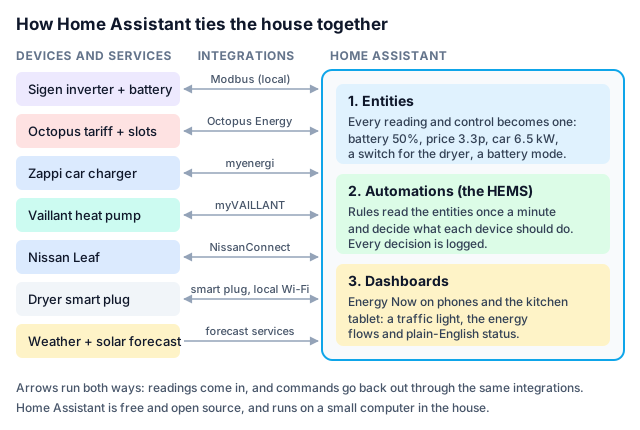
The HEMS reads everything through Home Assistant. That includes the Sigen inverter over local Modbus, the Octopus tariff and planned slots (Octopus Energy integration), the Zappi (myenergi integration), the heat pump (myVAILLANT integration), the Leaf's battery (NissanConnect), a dryer smart plug, and solar and weather forecasts. Once a minute it decides what each device should be doing. Every decision is rules-based and logged, and the whole thing can be turned off with one switch.
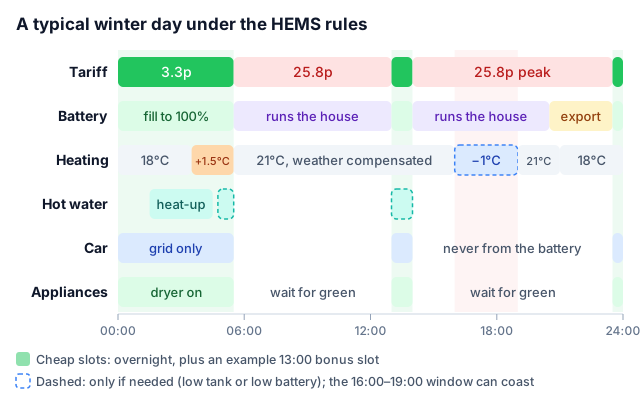
A typical winter day. Cheap periods (green) do most of the work: the battery fills, the car charges from the grid, hot water heats, the house pre-heats and the dryer runs. In the peak window (red), the heat pump can coast if the battery is low. The 13:00 bonus slot is an example; Octopus moves them around from day to day.
Battery and EV rules
The battery is controlled through the Sigen's remote energy management interface, following a fixed order of priorities:
| Situation | What the battery does |
|---|---|
| Cheap slot (23:30–05:30, or any Octopus bonus slot) | Charges from the grid to 100%, with discharging blocked. The house and car run on cheap grid power. |
| Cheap slot, battery already full | Holds its charge. Everything runs on cheap grid power. |
| Car charging outside a cheap slot | Can still store solar, but never discharges into the car. |
| Evening, with spare charge | Exports the spare at 12p, timed to reach empty at 23:30, just as the cheap rate starts refilling it. |
| Overnight, battery full and car not charging | Exports as much as time allows while still refilling to 100% by 05:30. |
| Otherwise | Normal self-consumption: the battery runs the house. |
A measured cold day and summer day, hour by hour
Both days are from before the HEMS went live, with the battery on Sigen's own AI Mode. 13 March was chosen as one of the coldest days since the heat pump was installed in February. Select a series to show or hide it; hover for the values in each hour.
Cold day: 13 March 2026, 4.5°C average
Look for: battery empty: peak-rate imports.
Summer: 15 July 2026, 14°C average
Look for: battery feeding the car / battery exported at 12p.
Cheap rate 23:30–05:30. Above zero: importing, charging or using; below zero: exporting or discharging. *Heat pump and car are split out of the house load and scaled to each day's metered totals.
These two days show why the rules above exist. On the cold day the battery fills overnight, but the heat pump draws around 1–1.5 kW all day and there's little solar. The battery is empty by about 20:00, and the house then imports at the peak rate until 23:30. That gap is what the daytime battery top-ups, pre-heat and coast are aimed at. On the summer day, solar covers the house and fills the battery by late morning, and the surplus is exported. But look at the first hour: while the car charges at the cheap rate, the battery is discharging into it. That's the problem the EV guard now stops. The late-evening export, timed before the cheap refill, is the arbitrage the evening export rule now handles.
- EV guard and hands-free charging. If the battery is ever seen feeding the car for two minutes, its discharge is cut to zero until the car stops. This applies whatever is in control of the battery. The car can now stay plugged in and use every cheap slot, without anyone timing it.
- Battery charging in every cheap slot. The battery now tops up in daytime bonus slots as well as overnight. This matters most in winter (see below). Octopus applies the cheap rate to the whole home in these slots, within the car's daily allowance, so every kWh the battery stores then is bought at 3.3p.
- Evening export and overnight cycle. Exporting at 12p and refilling at 3.3p clears about 8p/kWh after round-trip losses. On nights the car isn't charging, the battery can export roughly 8 kWh between midnight and 02:45 and still be full by 05:30. Predbat, an open-source battery optimiser, runs alongside in monitor mode as a benchmark for these fixed rules.
Heat pump rules
The heat pump keeps its own schedule (21°C from 04:30 to 21:00, with an 18°C setback overnight) and its weather-compensation curve. A single Control mode switch chooses between "Schedule only" and "HEMS smart". In smart mode, HEMS adds four actions. Each one is a single instruction to the heat pump that undoes itself:
| Rule | When it runs | What it does |
|---|---|---|
| Pre-heat | A cheap window with at least 30 minutes left, outdoor temperature below 10°C, and heating still wanted for at least an hour after the cheap rate ends | Raises the room target by +1.5°C (up to a 23°C cap) until the cheap rate ends |
| Coast | The 16:00–19:00 peak, with the battery below 40% | Lowers the room target by −1°C (no lower than 19°C) until 19:00 |
| Night hot-water check | 15 minutes after the 01:30–04:30 hot-water programme, if the tank finished more than 5°C below target | Boosts the cylinder before the cheap window closes |
| Daytime hot-water top-up | Tank below 40°C, during a cheap slot or a solar surplus | Boosts the cylinder, and stops if the slot ends or the grid or battery starts paying for it |
Changing the room target matters because Vaillant's heating curve is anchored on it. Change the target and the whole curve shifts. I measured this on the first morning. With the outdoor temperature steady at 2.2°C, the routine step from the 18°C setback to the 21°C comfort setting moved the flow-temperature target from 31.8°C to 36.8°C. That's about 1.7°C of flow temperature for every 1°C of room target. So pre-heat adds about 2.5°C of flow temperature and coast takes off about 1.5°C. Either way, the system is still running on weather compensation, just on a slightly warmer or cooler curve for a few hours.
Pre-heat stores heat in the building fabric at the cheap rate, so the heat pump does less work at 25.8p after 05:30 and the battery lasts longer into the day. It only runs when that heat will actually be used. A 20:00–21:00 bonus slot that ends just as the evening setback begins doesn't trigger it.
Coast covers the other end of the day. If the battery is already low at 16:00, the house is about to import at the peak rate. Letting the rooms drift by a degree for up to three hours draws on heat already stored in the fabric. In a low-temperature system, nobody notices.
High-load appliances
The heat pump, battery and car are easy to automate. Washing machines, dryers and dishwashers are harder, because someone has to load them.
Tumble dryer (automated). The dryer is plugged into a smart plug that only has power during cheap slots. You load it, set the timer and press Start. If it's peak time, nothing happens until the cheap window opens, then HEMS switches the plug on and the timer counts down. Our dryer works on a timer rather than programme cycles, so if a slot ends mid-load it simply pauses and carries on in the next one. A dropdown chooses between "night rate only" (the default) and "any cheap slot". There's also a confirmed "Run now" override. At about 2.5 kW, the dryer is the biggest appliance load in the house.
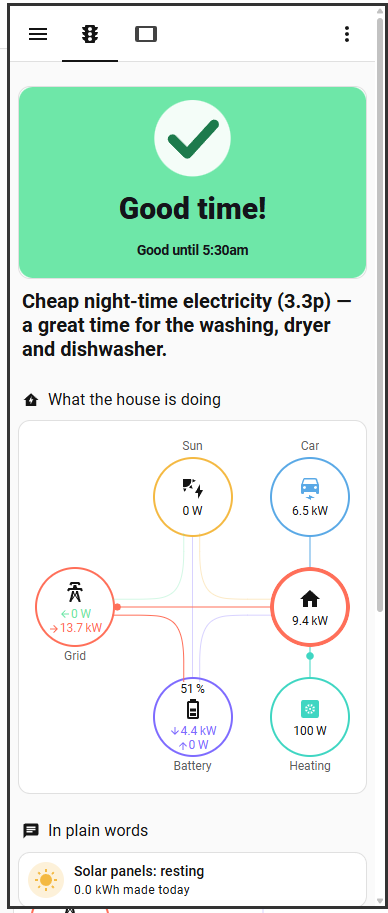
Washing machine and dishwasher (guided). These run programme cycles that shouldn't be cut off mid-wash. Instead of a smart plug, HEMS gives the family a single traffic-light signal on a phone and wall-tablet dashboard called Energy Now. A pixel clock in the kitchen is next.
- 🟢 Good time! A cheap slot or a solar surplus. Run the washing machine, dryer and dishwasher.
- 🟠 OK for short loads. Peak rate, but the battery is at least 40% full and not being held for the car.
- 🔴 Best to wait. The battery is low, being held for the car, or exporting in the evening. The display shows when the next good time starts.
The light uses the same cheap-slot and solar signals as everything else, including Octopus's bonus slots and a sunny-spell forecast from Forecast.Solar. Both appliances have delay-start timers, which makes a green light easy to act on.
Energy Now is there for everyone in the house, on their own phone or the wall tablet, at any time. Nobody needs to understand the tariff, the battery or the heat pump to use it. They just need to know whether the light is green.
What it's worth
Cost savings by rule
Here is my best estimate of what each rule adds each year, on top of the £2,216 a year the solar, battery and heat pump already save on their own. It uses the 3.3p, 25.8p and 12p rates, the house's measured load model and the first day's operation. The load model was fitted from 230 days of data: 15.1 kWh a day of baseload, plus 2.17 kWh for every degree-day of heating. The ranges are deliberately wide.
| Rule | How it saves | Extra saving per year (estimate) |
|---|---|---|
| EV guard and hands-free charging | Keeps the battery for the house, so it isn't empty when a car charging slot ends and the house falls back on peak-rate grid power | £40–100 |
| Battery top-ups in daytime cheap slots | Refills the battery when it runs low in winter, so the evening runs on cheap energy | £40–90 |
| Overnight battery cycle | About 8 kWh exported at 12p and refilled at 3.3p, on nights the car isn't charging | £90–150 |
| Evening export | Spare charge sold at 12p before the cheap refill (Sigen's own AI mode already did some of this) | £15–40 |
| Heat pump pre-heat | 1–2 kWh of morning heating moved to the cheap rate on cold days | £30–60 |
| Heat pump coast | Peak-rate heating avoided on winter afternoons when the battery is low | £10–25 |
| Hot-water checks and top-ups | Mainly comfort and reliability: no cold mornings and no manual peak-rate boosts. Close to cost-neutral | £0–10 |
| Dryer on a cheap-slot plug | About 375 kWh a year moved out of peak and battery hours | £30–60 |
| Washing machine and dishwasher (traffic light) | Part of about 450 kWh a year nudged into green periods | £15–35 |
| Total | £270–570 |
Estimated extra saving per rule, £ a year (midpoint of each range)
Chart data
| rule | saving |
|---|---|
| Overnight battery cycle | 120 |
| EV guard | 70 |
| Daytime battery top-ups | 65 |
| Heat pump pre-heat | 45 |
| Dryer plug | 45 |
| Evening export | 28 |
| Washer & dishwasher | 25 |
| Heat pump coast | 18 |
| Hot-water rules | 5 |
The midpoint is roughly £420 a year, about 19% on top of the home technology savings. That's enough to cover the £347 net running cost forecast for 2026 as a whole, so over a full year the house and car could cost close to nothing to run, not just in summer.
At a more typical 7p off-peak rate, the gap between cheap and peak rates narrows from 22.5p to 18.8p. The value of moving demand falls by about a sixth, and the battery's export margin roughly halves. On those rates I'd expect something nearer £200–420 a year. That's still worthwhile, but it shows how much of the value comes from the tariff.
Winter: topping up the battery in daytime cheap slots
This is the rule I expect to make the most noticeable difference to the average price we pay for imported electricity in winter.
In summer, solar refills the battery through the day. In winter it can't. With the heat pump running and only a few kWh of solar, our 10 kWh battery (about 9 kWh usable) can be empty by midday or early afternoon. On 18 October it went from 90% at 06:00 to 1.5% by 09:30. From then until 23:30, every kWh the house uses comes from the grid at 25.8p.
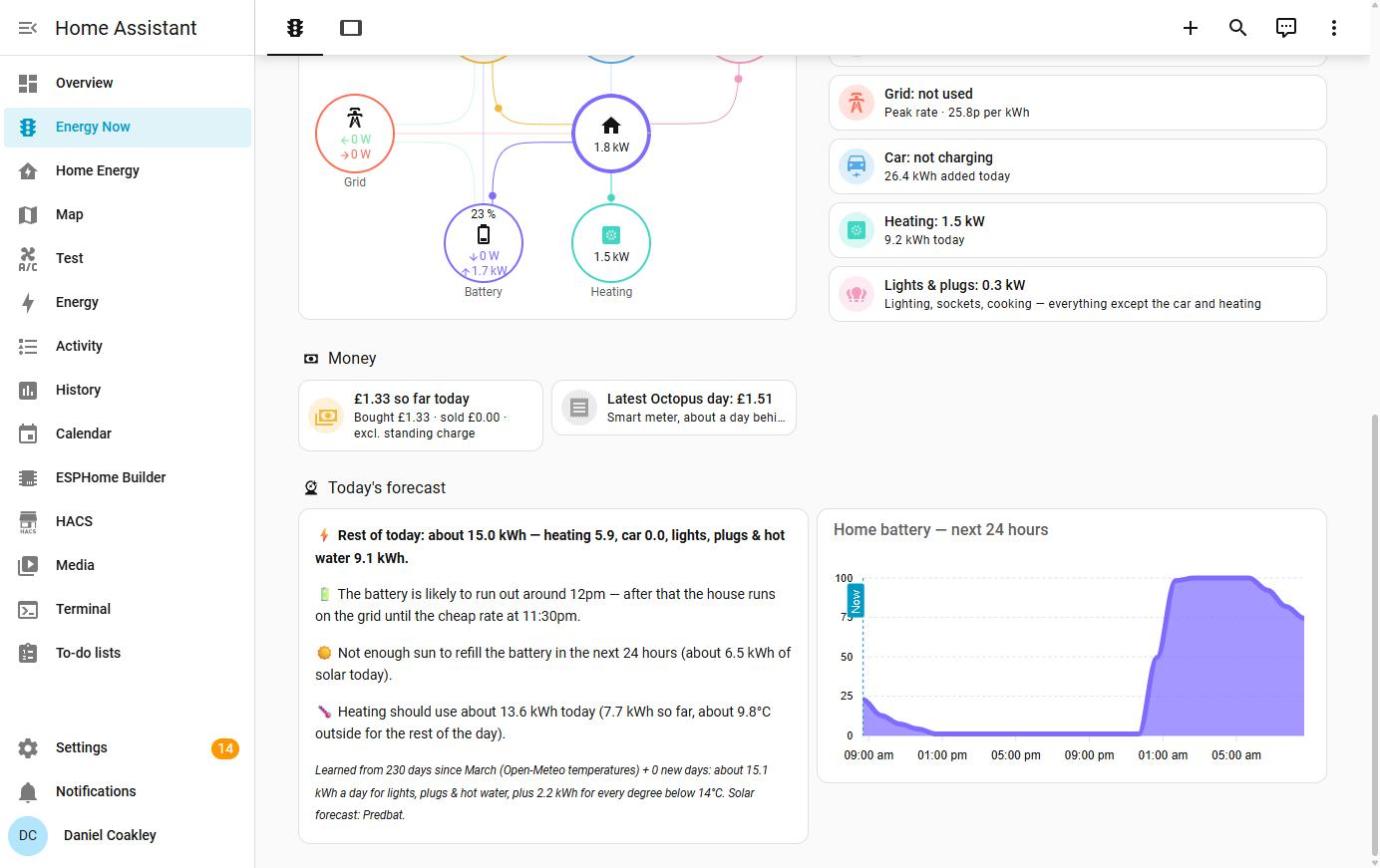
Why the winter top-ups matter. The HEMS forecast for a cold morning: the battery runs out around midday, and without a top-up the house runs on peak-rate grid power for the next eleven and a half hours. The forecast is built from the house's own load model and Predbat's solar forecast.
A daytime bonus slot changes that. Even 30–60 minutes at the battery's 4.4 kW charge rate puts back 2–4 kWh. That's enough to carry the house through the late afternoon and into the evening, saving 22.5p on every kWh it would otherwise have imported at peak. It's worth roughly 50p–£1 each time. Bonus slots only appear when the car is plugged in and needs charging, which is now automatic. A couple a week through the winter adds up to the £40–90 in the table above.
It also lowers the average price per kWh imported, the clearest single measure of how well the house uses the tariff. On day one, imports averaged 6.1p/kWh, 76% below the peak rate, because almost everything was bought in cheap slots. That figure is on the Live tab, and I'll be watching it through the winter.
Carbon savings from cleaner periods
There's a carbon benefit too. Overnight and in Octopus's bonus slots, demand is low and wind makes up a bigger share of the mix, so less gas generation is running. In the early evening, demand peaks and gas fills the gap.
Electricity Maps' review of 2025 puts numbers on this for Great Britain. In winter, carbon intensity peaked at about 234 gCO₂e/kWh at 17:00 and fell to about 149 at 03:00, a gap of 85 g. In autumn the gap was 73 g (215 at 18:00 against 142 at 02:00). The national carbon intensity forecast shows the same pattern day to day.
GB grid carbon intensity in 2025, gCO₂e/kWh: dirtiest vs cleanest hour by season
- Dirtiest hour (evening)
- Cleanest hour
Chart data
| season | Dirtiest hour (evening) | Cleanest hour |
|---|---|---|
| Winter | 234 | 149 |
| Spring | 223 | 124 |
| Summer | 210 | 113 |
| Autumn | 215 | 142 |
My estimate of the extra carbon saving, over and above the technology switch itself:
- Load moved into cheaper, cleaner periods. Pre-heat, the dryer, guided washing, winter battery top-ups and the EV guard (which keeps the battery for the house through the evening peak) together move about 800–1,500 kWh a year. At a 60–85 g/kWh difference, that saves 50–130 kg CO₂e.
- Heat not needed. Coasting avoids perhaps 50–100 kWh of peak-time heating, saving another 10–20 kg.
- Battery trading roughly cancels out. Evening export displaces some evening gas generation. The overnight cycle, though, is a money-making rule, not a carbon one: it loses about 10% to battery round-trip losses.
That nets out at roughly 50–150 kg CO₂e a year. It's modest next to the switch itself, which cut the house's estimated emissions from about 6.8 tonnes to 0.5 tonnes a year, so it adds a further 1–2%. But it costs nothing extra, and it's a cautious figure. It uses average grid intensity. The power actually displaced at the evening peak is mostly gas, which is much more carbon-intensive than the average, so the true saving is probably higher. It's also exactly the kind of flexibility a grid with more and more wind needs: demand that moves to soak up surplus renewable output rather than adding to the evening peak.
What could make these numbers wrong
- The rules overlap. Pre-heat, coast, the dryer and the winter top-ups all help by keeping the battery charged for longer. On a day the battery would have lasted anyway, the same value can't be counted twice. I've tried to allow for that in the ranges, but the total isn't a simple sum.
- Battery wear. The overnight cycle adds roughly one extra charge cycle on most nights. That's real wear against the battery's warranty and needs weighing against the extra income.
- Thermal mass hasn't been measured. The pre-heat and coast estimates assume the house holds heat for a few hours, which is how it feels. A meter on the heat pump's supply is on the list, so pre-heat can stop once the house is up to temperature.
- Weather and behaviour. A mild winter shrinks the heat pump savings. A family that ignores the traffic light shrinks the appliance savings.
Why low flow temperatures make this possible
This is the point I most want to get across. The heat pump rules only work this well because the system was designed for low flow temperatures from the start. The radiators were sized for the heat pump, and the shallow 0.55 heating curve runs at about 31°C at 10°C outside and 38°C at 0°C.
Shifting heat into a building in time comes down to three things: efficiency, headroom and recovery.
- Efficiency. At these flow temperatures the heat pump runs at a COP of around 4, so pre-heating at 3.3p delivers heat for under 1p per kWh, against about 6.5p at the peak rate. A high-temperature design running at 50–55°C has a COP nearer 2.5, so every kWh of heat it stores costs more.
- Headroom. Pre-heating means pushing extra heat into the fabric, so asking the radiators for more than the house strictly needs. Large, low-temperature radiators can do that with a 2.5°C nudge in flow temperature. A system with undersized radiators, already running hot just to keep up, has little left to give. The higher flow temperatures it would need make the heat pump least efficient at exactly the moment it's storing heat.
- Recovery. Coasting only works if the house can get back to temperature afterwards without a big efficiency penalty. A low-temperature system with generous radiators recovers gently. A high-temperature system has to run harder and hotter to catch up, which can cancel out what the coast saved.
Cost of a kWh of heat, pence: heat pumps at cheap and peak rates vs a gas boiler
- Cheap period (3.3p electricity)
- Peak period (25.8p electricity)
Chart data
| design | Cheap period (3.3p electricity) | Peak period (25.8p electricity) |
|---|---|---|
| Heat pump, low temp (COP 4) | 0.8 | 6.5 |
| Heat pump, high temp (COP 2.5) | 1.3 | 10.3 |
| Gas boiler (90% efficient) | 5.4 | 5.4 |
The gas boiler comparison makes the point sharper. Even a modern boiler at 90% efficiency produces heat for about 5.4p per kWh, whatever the time of day. A well-designed heat pump beats that by a wide margin in cheap slots (under 1p), and only loses to gas at the peak rate. A high-temperature heat pump running at peak costs nearly twice as much as gas. That's why shifting heat into cheap periods matters so much, and why the battery and pre-heat rules keep the heat pump off the peak rate wherever they can.
In short, a well-designed low-temperature system turns the building into a thermal battery. A high-temperature one, at best, is a heater that can be switched off. That's another reason to get the design right at installation. The right radiator sizes and the right curve make every future tariff and control strategy more valuable.
A normal house, not a showcase
It's worth being clear about what this house is and isn't. It hasn't had a deep fabric retrofit. The windows are still the original older double-glazed units. The only fabric work was cheap, high-impact: 150 mm of insulation under the suspended timber floor and a loft top-up to 270 mm, both minor costs next to the main systems. There's no external wall insulation, no triple glazing and no Passivhaus detailing.
That's deliberate, and it's the point. Most UK homes will decarbonise much like this one: modest fabric improvements, sensible system design, and smart use of tariffs and controls. Everything in this post can be done in an ordinary house on an ordinary budget.
Live data on the dashboard
The second big change is transparency. The Home Energy Transition dashboard now has a Live tab, fed directly from Home Assistant:
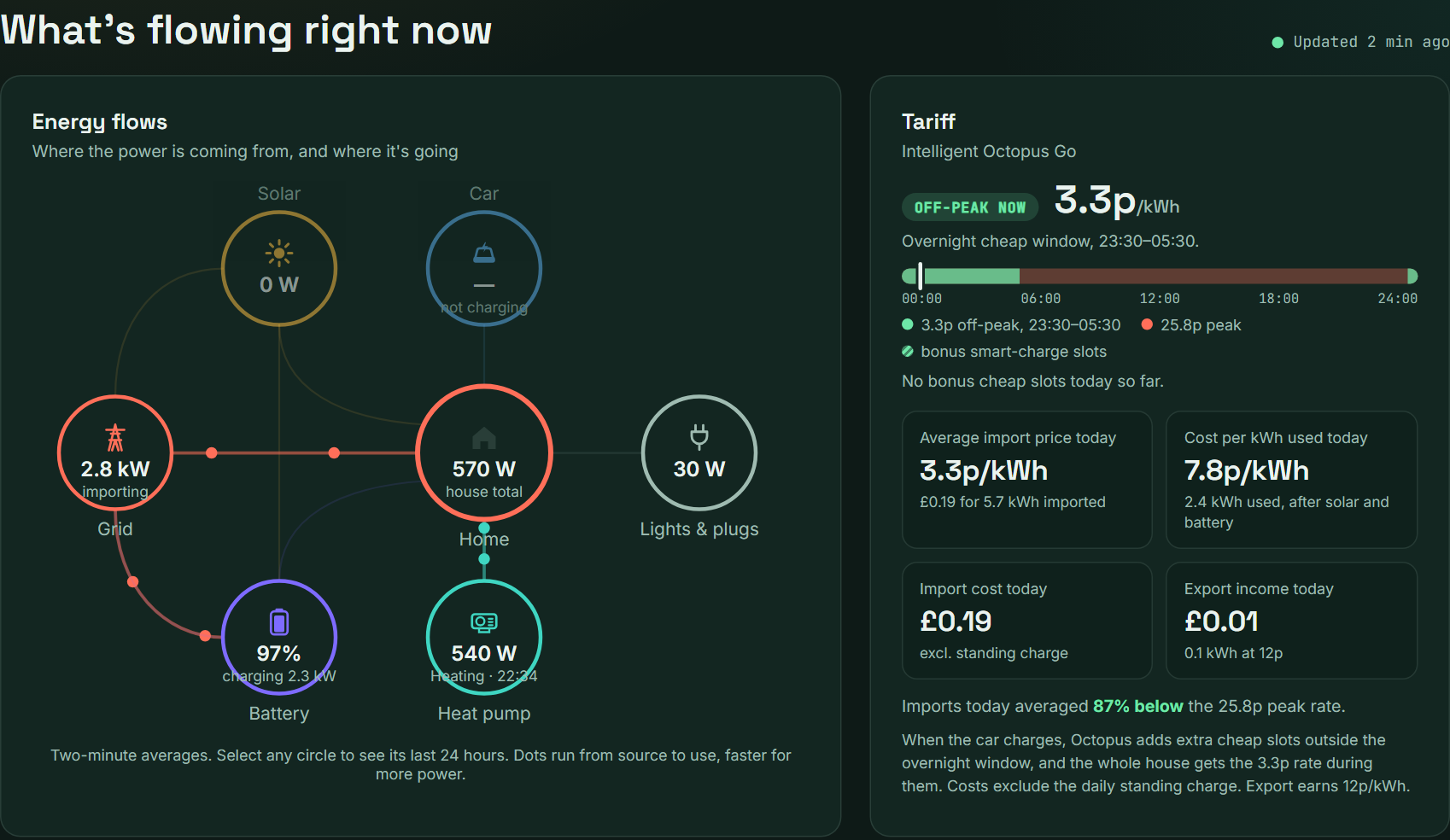
Overnight, in the cheap window. The diagram shows power moving between the solar panels, battery, grid, car, heat pump and the rest of the house, as two-minute averages. Select any circle to see its last 24 hours. The tariff panel shows the current rate, the overnight window, today's bonus slots, and what imports have actually cost so far today.
This snapshot, taken just after midnight, shows the overnight plan at work. The house is running on 3.3p grid power. The battery is filling at 2.3 kW, almost full and ready for the morning, and the heat pump is heating the house on the same cheap power. The car isn't charging, because it doesn't need to tonight. On the HEMS's first full day, imports averaged 6.1p/kWh, 76% below the peak rate, because almost everything was bought in cheap slots. Every kWh the house used that day, after solar and battery, cost 6.3p.
Alongside the live view, the year-to-date running costs and savings now update every day. Daily totals are sent from Home Assistant each night, so the headline figures, the monthly table and the baseline comparison keep moving through the year instead of being frozen at the time of writing. The dashboard will keep developing as the HEMS beds in. Next on the list are heat pump COP from the new data and the measured effect of each rule.
The aim is an open, honest view of what these technologies really save, and how they work together, in a normal home. That means real meter readings, the things that went wrong as well as the things that went right, and a clear line between what's measured and what's modelled.
What I'll be monitoring over the next year
The HEMS has been live for a day, so this is the start of the experiment, not the result. Over the next twelve months I'll be tracking:
- Actual savings against the estimates above, rule by rule where the data allows. Every HEMS action is logged, so its timing can be matched against prices.
- The average import price through winter, and how often daytime bonus slots rescue an empty battery.
- Pre-heat and coast in a real winter. Does the flow temperature step as expected, does comfort hold, and how much morning peak demand actually moves?
- Battery wear from the overnight cycle, against the extra income.
- Predbat against the fixed rules. If its forecast-based plan beats them over a few weeks, it takes over the battery.
- Hardware upgrades: a meter on the heat pump's supply for true live power and COP, and a physical traffic-light display in the kitchen.
I'll publish an update after the first full winter and again after a full year, using the same dashboard so the numbers can be checked. If these estimates turn out to be wrong, the update will say so.
Takeaways
- The technology sets the ceiling; the controls decide how close you get to it. The switch to a heat pump, solar, a battery and an EV did the heavy lifting. A rules-based HEMS is expected to add another £270–570 a year, with no new hardware beyond a smart plug.
- Software beats wiring. Physically separating the EV charger from the battery stops one problem. A HEMS solves it and opens up daytime cheap slots for the car, the battery and the household's heavy loads.
- Winter is where it matters most. Topping up the battery in daytime cheap slots keeps the house off the peak rate on exactly the days the battery would otherwise run out by lunchtime.
- Cheaper is usually cleaner. Moving demand into cheap periods also moves it into lower-carbon ones. That's a small extra carbon saving here, but it's the kind of flexibility a wind-led grid needs.
- Designing for low flow temperatures pays twice: once in efficiency, and again in flexibility. It's what turns the house into a thermal battery.
- It works in an ordinary house. Older double glazing, modest fabric upgrades, and still on course to cost close to nothing to run.
References
- Octopus Energy, Intelligent Octopus Go, Smarter charging for a greener grid, Intelligent Octopus Go rates from October 2025 and Outgoing Octopus
- Octopus Energy, April 2026 price cap updates
- Energy UK, Energy UK explains: April 2026 price cap
- Electricity Maps, Grid in Review 2025: Great Britain
- National Energy System Operator, Carbon Intensity API and forecast
- Home Assistant, with the Sigenergy Local Modbus, Octopus Energy, myenergi, myVAILLANT and NissanConnect integrations
- Predbat battery optimiser, Forecast.Solar and the myenergi Zappi
- My earlier write-up of the Home Energy Transition and the Home Energy dashboard
Discuss this research
Want to explore how these findings apply to your portfolio or organisation?
Get in touch